Medical technology
The capital region is one of the most innovative medical technology hubs in Europe and has undergone high growth momentum for many years.
companies
employees
Many of the medical-technology companies in the capital region are small to medium in size and find themselves among world leaders in their respective segments. They benefit from excellent academic research and the various opportunities for cooperation with renowned research institutes and hospitals.
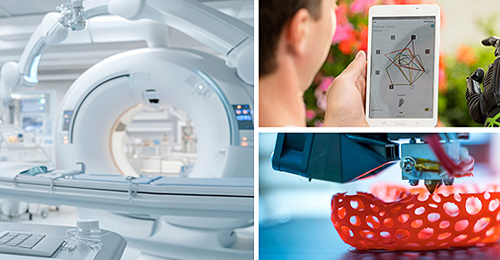
The industry is very heterogeneous and covers a broad spectrum – ranging from software development for digital health solutions and medical imaging to the development of electromedical and medical devices to the manufacture of implants and medical aids for orthopedics and care.
Among the leading companies are, for example:
- Biotronik
- B. Braun
- Berlin Heart
- bess
- Caresyntax
- Eckert & Ziegler
- eemagine Medical Imaging Solutions
- Hologic
- Jenoptik
- Karl Storz
- MELAG
- Novanta
- Ottobock
- Stryker
- XION
- Zimmer Biomet
(Source: Berlin Partner for Business and Technology)
Research and Development
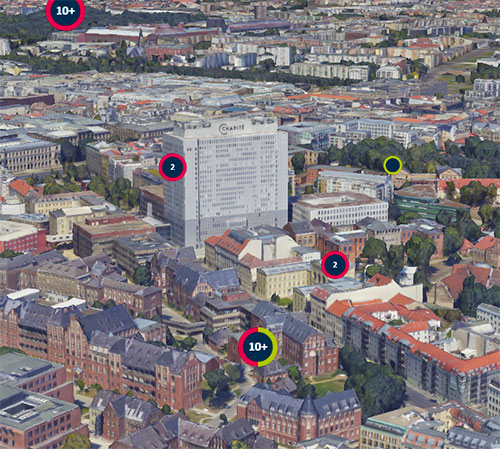
In addition to Charité – Universitätsmedizin Berlin and the Medical University of Lusatia – Carl Thiem (MUL-CT), the German capital region is home to over 40 renowned scientific institutions, including the Berlin Institute of Health (BIH), the Charité German Heart Center (DHZC), the National Metrology Institute of Germany (PTB), and numerous Fraunhofer, Helmholtz, Leibniz, and Max Planck Institutes across Berlin and Brandenburg.
The wide range of research offered by Berlin’s scientific and research institutions encompasses not only traditional core areas of medical technology – such as those covered by the Department of Medical Engineering at TU Berlin – but also a broad spectrum of cross-disciplinary technologies. These include, among others, microsystem and nanotechnologies, sensor technologird, optical technologies, robotics, digital technologies, new materials, biomechanics and many others.
With a highly diverse population and its location at the intersection of metropolitan and rural areas, the German capital region offers ideal conditions for the research, development, and testing of innovative and connected healthcare solutions.
Science and research institutions
Networks
In order to combine and optimally use the available expertise and resources, very early on, the capital region began establishing specialized networks. These have contributed significantly to the region’s advancement to become one of Europe’s leading locations for life sciences.