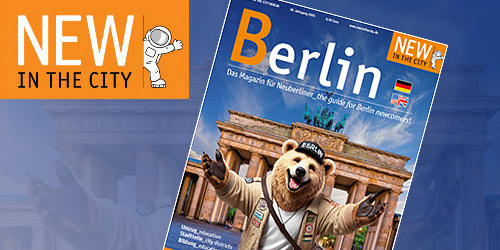
Information for new Berliners
Some consider it to be the capital of startups and creative people, for others, it is a multicultural metropolis with a high leisure and entertainment value – welcome to Berlin!
In an urban area of around 891 km², approx. 3.9 million Berliners can find unique leisure, culture and training possibilities to shape their lives.
And not only that: Berlin combines idyllic peace and nature with a vibrant large city. The forests, rivers and lakes around Berlin create a diverse natural and recreational environment, optimally connected to Germany’s largest transport association (Berlin-Brandenburg transport association).
The German capital is a young and cosmopolitan city: 56 percent of the inhabitants are younger than 45, 25 percent of the total population come from abroad.
Worth knowing:
- Berlin is a federal state and consists of twelve districts.
- Almost one third of Berlin’s city area are forests and green spaces, almost a tenth is lakes, rivers and canals.
- The green heart of Berlin, the “Großer Tiergarten” city park, is Germany’s third-largest inner city park with approx. 210 hectares of space. Additionally, there are about 2,500 public parks and recreation areas.
- People from more than 190 nations shape the capital’s thriving atmosphere.
- The average age of the population is 42.9 years.
(Source: Office for Statistics of Berlin-Brandenburg, 2026)
What do new Berliners have to consider when moving to Berlin?
At a first glance, Berlin appears to be vast to many newcomers. However, the life of many Berliners happens only in a small part of their city – their “kiez” as the neighborhoods are called here. Where do I have to register, how can I apply for a residence permit, where do I find appropriate child care services?
Urban variety, vibrant scene districts, busy strip malls or placid village idyll – every borough has its own charm with a characteristic living atmosphere.
Berlin is one of the most sustainable cities in the world
The German capital stands for continuous sustainable development – its many green spaces, low environmental impact and well-developed public transportation are Berlin’s strengths. This is the result of the sustainability ranking “Arcadis Sustainable Cities Index 2024” by the global company Arcadis. This compared the sustainability development of 100 international metropolises in the categories “People”, “Planet”, “Profit” and “Progress”. In the overall ranking, the German capital ranks eighth, making it one of the top 10 most sustainable cities in the world.
(Source: Arcadis Sustainable Cities Index 2024)