The automotive industry and its suppliers
The high quality and thematic breadth of the automotive industry and automotive-related research make the region an important location for the automotive industry.
Berlin is the only location in Germany with a significant presence of the three leading German manufacturers BMW, Mercedes-Benz, and Volkswagen. This is a unique combination of excellent R&D activities and high-quality production. Berlin offers attractive conditions for large, small, and medium-sized companies alike.
At a glance
- Over 200 automotive companies in the region, including 80 manufacturing and supply operations and various engineering firms that employ around 30,000 people;
- Around 25 academic institutions in the automotive industry;
- Optimal networking of the regional automotive industry in various networks and centers of expertise;
- Subsidies and incentives for capital investments, employee training, and research and development projects;
- Outstanding pool of highly qualified technical specialists and management talent due to various degree programs in the automotive field;
- Quick access to the automobile manufacturers in Lower Saxony, Saxony, Poland and the Czech Republic thanks to Berlin's central location in the heart of Europe;
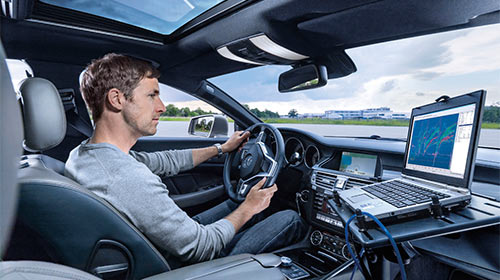
- Competence center for intelligent mobility and test field for networked and autonomous driving;
- A consortium of various automotive companies offers expertise in the form of a center for clean energy drive technology.
Selected companies in the automotive industry
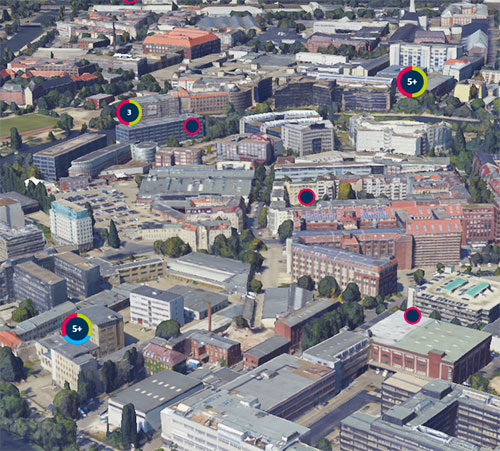
The range of companies is wide and varied. Major original equipment manufacturers (OEMs) such as Mercedes-Benz, Tesla, and BMW are joined by global players in the supplier industry, including Bosch, Brose, Gestamp Umformtechnik, Goodyear Dunlop, Knorr-Bremse, Pierburg (Rheinmetall), Schaeffler, ZF, and a large number of strong medium-sized companies.
- BMW's Berlin plant has once again set sales records for its motorcycles.
- The Mercedes-Benz plant in Berlin is responsible for the production of various powertrain components. By assembling high-performance electric motors, the facility is expanding its electric vehicle portfolio. In addition, as part of the global network known as the “Mercedes-Benz Digital Factory Campus,” the plant plays a key role in the digitalization of production.
- Luxsoft, CARIAD (VW), and MBition (Mercedes-Benz) develop and implement software for vehicles.
- The Schaeffler Group operates a major development and competence center for modern drive technology in Berlin. This is where innovative components for battery-electric and hybrid vehicles are developed. Another focus is on the design of electric axle drives, power electronics, and control technologies.
Flagship stores of major automobile producers in Berlin
Networks, initiatives and associations
Research environment
The universities in the region offer degree programs, among others, in the following fields of study:
- Mechanical Engineering and Transport Systems – TU Berlin
- Vehicle technology – HTW Berlin
- Mechanical Engineering – BTU Cottbus-Senftenberg
- Mechatronics / Automation systems – FH Brandenburg
- Industrial Engineering – Berliner Hochschule für Technik
Companies and their suppliers benefit from a strong regional research network:
- Technical University Berlin (TU Berlin)
- Fraunhofer Institutes (Fraunhofer Institute)
- Technical University of Cottbus
(Brandenburgische Technische Universität Cottbus-Senftenberg - BTU) - Technical University of Applied Sciences Wildau
(Technische Hochschule Wildau - TFW) - German Aerospace Center (Deutsches Zentrum für Luft- und Raumfahrt - DLR)
Berlin is a major research location for new propulsion systems and drive energies (clean energy):
- Clean Energy Partnership (CEP)
Cross-industry expert panel on hydrogen mobility from the automotive and energy sectors - TU Berlin, Institute of Land and Sea Transport, Department Automotive Engineering
Research focus: complete vehicle concepts based on conventional and alternative drive technologies
Further research topics and test fields in industry:
- The Digital Urban Traffic Test Bed
Automated and connected driving, environmentally sensitive traffic management - Roadmap for the implementation of automated and connected driving in public transport in Berlin
- ReTraNetz
Real-world laboratory for innovative production processes, process chains, and digital business models - NoWeL4
Pilot project by Berliner Verkehrsbetriebe (BVG) in collaboration with partners from industry and science to test autonomous shuttle vehicles in northwestern Berlin