Non-university research institutions in Berlin
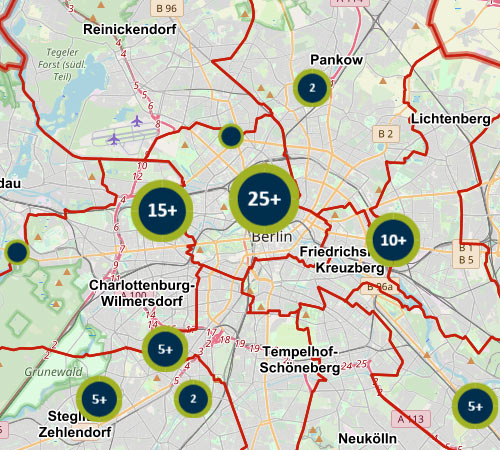
With more than 70 non-university research institutions, Berlin, together with its universities of applied sciences and universities, forms one of Europe’s largest science and research hubs. Researchers from around the world value the city’s open research environment, diverse opportunities for collaboration, and strong links between academia and industry.
Humboldt and Einstein, Virchow and Koch, Meitner and Planck: Berlin’s scientific legacy is shaped by some of the world’s most influential minds. Leading national research organizations are represented in the city by multiple institutes and research facilities.
Fraunhofer Society
The Fraunhofer-Gesellschaft is Europe's largest organization for applied research with 74 facilities across Germany. It collaborates closely with industry and the public sector in fields such as health, energy, and mobility. Berlin is one of its key locations, home to several institutes and research alliances, as well as the Capital Office and the Fraunhofer Forum.
Hermann von Helmholtz Association
The institutes of the Hermann von Helmholtz Association of German Research Centers conduct research in the fields of natural-science and technology as well as biology and medicine. The Helmholtz Association has 18 research centers throughout Germany, two of which are in Berlin. In addition, three branch offices of the Helmholtz Association are located in Berlin, including a location of the German Aerospace Center (DLR).
Max Planck Society
The Max Planck Society maintains 85 institutes and research institutions that carry out basic research in the natural sciences, life sciences, and humanities.
In addition to five institutes, Berlin is also home to the Capital Office, the Max Planck Unit for the Science of Pathogens (MPUSP), an archive, and the “Harnack-Haus” conference center.
Gottfried Wilhelm Leibniz Scientific Association
The Leibniz Association comprises 96 research institutions and is jointly funded by the German federal and state governments. It conducts research on issues of societal relevance, provides research infrastructures, and advises policymakers, businesses, and the public. Berlin is its largest location, hosting 15 Leibniz institutes, additional affiliated facilities, and the Association’s headquarters. Through joint faculty appointments, the institutes maintain close links with Berlin’s universities.