Top 25 Meeting Destinations in Europe – Cvent Top Lists 2026
Berlin maintains its seventh place position in the European MICE ranking.
Berlin is one of Europe's top seven MICE destinations – as confirmed by the ranking from the international event platform Cvent, which analyzes the world's most important conference destinations annually.
Key factors include, among other things, the wide range of conference and event venues and the vibrant urban atmosphere of the German capital. In addition, Berlin boasts a rich historical and cultural heritage as well as a wide variety of recreational activities, including museums, galleries, restaurants, and a vibrant nightlife scene.
Germany Start-Up Barometer, July 2026 – Ernst & Young
Berlin reclaims the top spot from Bavaria
In the first half of 2026, approximately 5.3 billion euros in venture capital flowed into German start-ups, an increase of 14 percent compared with the same period last year. Despite the increase in investment volume, the number of funding rounds fell by 11 percent to 354.
Berlin’s investment returns to the top position: At just under 1.7 billion euros in raised capital, Berlin recorded the highest investment volume of all the federal states. This puts Berlin ahead of Baden-Württemberg (about 1.6 billion euros) and Bavaria (more than 1.1 billion euros).
Technology-driven business models were in particularly high demand. The sectors with the highest levels of investment included hardware, software, and analytics, as well as defense, health and energy.
Migrated skilled workers – German Economic Institute (IW)
Berlin is Germany's most attractive location for international skilled workers
International skilled workers and university graduates move particularly frequently to city states and western German federal states – as shown by the “IW Short Report 30/2026” of the German Economic Institute (IW). In a nationwide comparison, Berlin is the clear leader, attracting the most foreign skilled workers of working age between 25 and 64. In 2024, one in four qualified professionals in Berlin was born abroad..
27.1 % of the specialists were born abroad,
41.9 % of immigrants are college graduates,
35.1% of all university graduates in Berlin are from abroad,
14.3 % of the total working‑age population are university‑educated migrants.
In addition to jobs and career opportunities, factors such as cosmopolitanism, a welcoming atmosphere, and quality of life are also key considerations when choosing where to live and work. International communities, bilingual schools and daycare centers make it easier to settle into the city and help you get settled quickly.
X.1,With a university degree,With a vocational qualification,Without a vocational qualification,In education or training
Germany,6.1,7.9,10.4,0.4
Berlin,14.3,6.5,12.6,0.7
Hamburg,9.9,8.7,13.6,0.7
Hesse,7.7,9.5,13.3,0.4
Bremen,7.2,9.9,19.6,0.5
Baden-Württemberg,6.7,10.4,12.0,0.4
Bavaria,7.1,9.0,9.1,0.3
North Rhine–Westphalia,5.5,8.3,13.0,0.4
Rhineland-Palatinate,5.4,8.3,11.3,0.4
Lower Saxony,4.2,7.5,9.8,0.3
Saarland,3.8,7.9,11.1,0.4
Schleswig-Holstein,4.0,5.7,8.5,0.4
Saxony,4.3,3.5,3.7,0.1
Thuringia,3.4,3.6,4.4,0.2
Brandenburg,3.5,2.9,3.7,0.2
Saxony-Anhalt,3.0,3.4,3.5,0.4
Mecklenburg–Western Pomerania,3.0,3.3,2.9,0.1
Global Best to Invest 2026 – Site Selection
The Berlin-Brandenburg metropolitan region ranks 8th worldwide
Despite challenging economic conditions, the Berlin-Brandenburg metropolitan region continues to establish itself as an attractive hub for innovation and investment with international significance – a fact confirmed by its 8th-place ranking in Site Selection magazine’s “Global Best to Invest 2026” global ranking. It thus ranks alongside metropolitan areas such as Amsterdam, Melbourne, Seoul, and Tokyo-Kanto. In the "Western Europe" category, the capital region ranked third among the top five metropolitan areas, behind London and Amsterdam and ahead of Madrid and Paris.
United Kingdom – London
Singapore – Singapore
South Korea – Seoul
China – Shanghai
Netherlands – Amsterdam
Australia – Melbourne
Japan – Tokyo-Kanto
Germany – Berlin
Site Selection is a B2B trade magazine and analysis portal for global location and investment decisions. The “Global Best to Invest” rankings evaluate countries and metropolitan regions based on their economic attractiveness and investment potential – primarily using hard factors such as economic dynamism, investment, infrastructure, the labor market, wage levels, and innovation capacity.
Berlin combines a high quality of life with strong innovative power—as confirmed by the annual “Europe’s Best Cities 2026” ranking by the consulting firm Resonance Consultancy. Berlin retains its third-place ranking behind London and Paris, remaining one of Europe's highest-rated cities.
The vibrant cultural and creative scene, the UNESCO-recognized club culture, and forward-looking projects such as Berlin TXL as a model location for climate-friendly urban development are particularly highlighted. Strong tourist demand, with around 30 million overnight stays, also reinforces Berlin's leading position.
The top 10 best cities in Europe:
London
Paris
Berlin
Rome
Barcelona
Madrid
Amsterdam
Vienna
Copenhagen
Stockholm
For the ranking, more than 180 European cities with over 500,000 inhabitants were analyzed in the categories “Livability,” “Lovability” and “Prosperity.” The analysis is based on statistics as well as reviews from residents and visitors on platforms such as Google, Instagram, and TikTok. The ranking excludes all Russian cities.
Summer 2026 Business Location Ranking – Die Deutsche Wirtschaft
Germany's cities under the economic spotlight – Berlin holds onto third place
Berlin remains a dynamic business hub with a diverse business landscape. This is confirmed by the summer edition of the German Business Location Ranking (DDW). In a nationwide comparison, the capital once again ranks third – behind Munich and Hamburg.
The biannual study assesses the attractiveness of German cities to businesses based on various factors, such as corporate strength, small and medium-sized enterprises, international companies, investors, and hidden champions. In total, data from 4,041 locations was included in the analysis.
Results of selected sub-rankings
In the sub-rankings for “Number of Top Companies” and “Mid-Sized Companies (Top 10,000),” Berlin ranks second: 862 leading companies and 270 of Germany’s most significant mid-sized companies are headquartered in Berlin.
The capital city is also well-represented among global market leaders: 27 companies headquartered in Berlin are among the top players in their respective industries – including Knick Elektronische Messgeräte GmbH & Co. KG.
Another advantage is its appeal to international investors. 362 foreign-owned companies operate out of Berlin – ranking third nationwide. One example of this is TotalEnergies Holdings Deutschland GmbH and its French parent company.
Investors from the DACH region are also well represented: 152 of the 2,500 most important investors are based here, making Berlin the fourth-largest hub in Germany. These include, among others, Extantia Capital Management GmbH.
Berlin also remains a hub for future-oriented and trending industries: 130 companies operate in trending and innovative markets – including Thermondo GmbH, which specializes in energy solutions.
Thirty companies from Berlin were classified as hidden champions.
Berlin continues to expand its leading role as Germany’s startup capital and as one of Europe’s most important hubs for innovation – as shown by the new Berlin Startup Ecosystem Report. With a total value of 169 billion euros, Berlin accounts for 43 percent of Germany's startup ecosystem. More than 1,600 VC-funded startups, including 57 unicorns, are shaping the scene. Berlin is particularly strong in the fields of artificial intelligence and climate tech:
With over 9,000 AI experts, the city ranks among the top 3 locations for frontier AI in Europe.
More than 340 climate tech startups have raised over 800 million euros in funding since 2024.
The report identifies significant opportunities in the deep tech sector, particularly in the more effective translation of research findings into marketable innovations. One example of successful technology development is the Berlin AI Hub, which was launched by Berlin Partner.
The report was commissioned by the Senate Department for Economics, Energy, and Public Enterprises and prepared by the Dealroom agency; it compiles key figures, trends, and assessments regarding Berlin’s startup ecosystem. Senator for Economic Affairs Franziska Giffey emphasizes the goal of making Berlin Europe’s leading innovation hub – supported by a dynamic, creative startup ecosystem in which a new startup is launched every 14 hours.
Berlin Brandenburg Airport (BER) ranks 22nd in Travel And Tour World (TTW) magazine's "50 Best Airports in the World for 2026" ranking, making it one of the leading airports worldwide.
According to the ranking results, BER uses smart technologies such as automated security checks and digital services for passengers, takes sustainable processes into account, and ensures efficient procedures for travelers. This positions BER as a future-oriented, high-performance transport hub in Europe.
Berlin remains the leader in the number of financing rounds
Berlin will remain Germany's leader in terms of the number of financing rounds in 2025: of 716 successful deals nationwide, 218 were in the capital. This puts Berlin well ahead of Bavaria in second place with 149 deals. Nationwide, the number of financing rounds in 2025 declined for the fourth consecutive year – Berlin also recorded 38 fewer rounds than in the previous year.
Of the more than €8 billion in venture capital invested in German startups in 2025, €2.7 billion (32 percent) went to Berlin – a 23% increase over the previous year. This means that the capital remains one of the most important regions for tech investments in Germany, but for the second time in a row, it ranks behind Bavaria (3.3 billion euros) in terms of investment volume.
The German capital is one of the world's leading places to live, work, and invest, as evidenced by the annual "World's Best Cities 2026" ranking, which evaluates cities based on quality of life, economic strength, and attractiveness to young talent.
Berlin stands out thanks to its cultural diversity, innovative strength and growing international significance. Ranked ninth, Berlin is the highest-ranked city in Germany – a clear sign of the city's economic dynamism and international competitiveness.
London was voted the best city in the world, followed by New York and Paris. The US has the most representatives in the top 100 with 19 cities, followed by Germany (8) and China (7).
The ranking is published by marketing consultancy Resonance in collaboration with market and opinion research company Ipsos. The ranking is based on the Place Power™ Score, which combines 46 indicators in 30 categories. In addition to statistical data, experience factors as well as social media and review data are also taken into account. In addition, a global survey of 21,000 people was conducted.
Berlin ranks among the top cities both among city states and nationwide
Berlin remains the leading location in the comparison of city states, ahead of Hamburg and well ahead of Bremen. This is shown by the “Federal State Index for Family Businesses,” which evaluates the location conditions of the federal states in the areas of taxes, labor & human capital, financing, infrastructure and institutions from the perspective of family businesses.
Despite losing a few points, Berlin remains among the top performers nationwide, but now ranks behind the leading state of Saxony in comparison to the 2022 index. Berlin is particularly strong in the areas of labor and human capital, infrastructure, and, to some extent, institutions.
The index enables comparisons within the German federal system and is intended to make the economic performance of the federal states more transparent. It is published by the Family Business Foundation and compiled by ZEW – Leibniz Centre for European Economic Research GmbH.
Three freight village centers in the capital region among the top 20 in Europe
In the European GVZ ranking 2025 published by the German GVZ Association, three locations in the capital region secured a place in the top 20:
South Berlin – Großbeeren (11)
City Berlin Westhafen (12)
West Berlin – Wustermark (16)
The ranking lists GVZ Berlin Süd Großbeeren in 11th place among the top European locations. Berlin City GVZ Berlin (GVZ Berlin-Westhafen) and Berlin West Wustermark are ranked 12th and 16th in the "Established Performance Locations" category. This makes Berlin a strong player in the European network.
In the fourth GVZ ranking, which has been published every five years to date, around 230 GVZs in Europe were examined – this time with expanded benchmarking criteria, AI-supported location analysis, and an online questionnaire. Focus on current trends, sustainability, and innovative infrastructure.
Berlin moves up to fourth place among the world's most sustainable cities
Berlin ranks fourth among the world's most sustainable cities in the "Global Destination Sustainability Index 2025." This means that the German capital has moved up one place compared to last year. The result underscores Berlin's commitment to being one of Europe's most climate-friendly and livable destinations.
The leading international sustainability ranking for the tourism and events industry evaluates environmental, social, and economic criteria. The "Metropolis" category comprises 15 major international cities with more than 1.5 million inhabitants.
With an overall performance of 81 percent, the German capital ranks behind Melbourne, Singapore, and Barcelona.
The index evaluates the following four areas:
Urban environmental strategy and infrastructure
Social performance
Sustainability performance of service providers such as restaurants, hotels, or convention centers
With 31.6% of start-up votes, Berlin has retained its status as a key magnet for start-ups and confirms its position as one of Europe's most attractive innovation hubs, just behind London (32.6%).
Paris (18.9%) climbed two places to take third place in the ranking. Amsterdam (16.3%) remains in fourth place.
The Startup Heatmap Europe Report 2025 is based on an annual survey of European founders conducted since 2015 and offers a comprehensive overview of trends in the European startup landscape. The analysis covers over 100 cities across Europe and includes more than 150 accelerator programs. The focus is on trends in financing, international networking, talent availability, and the development of local startup ecosystems.
Location ranking winter 2025 – The German Economy (DDW)
Berlin stays in third place in the overall ranking
Berlin is a dynamic business location with a diverse corporate landscape – this is the conclusion reached by the latest winter edition of the Location Ranking of the German Economy (DDW). Berlin once again ranks third behind Hamburg and Munich.
The study, which is published twice a year, assesses how attractive German cities are for businesses – based, among other things, on their corporate strength and the importance of small and medium-sized enterprises, family businesses, international companies, investors, and – for the first time – hidden champions. A total of 4,030 locations were analyzed for this purpose.
Results of selected sub-rankings
In the sub-ranking of top companies at the location, Berlin ranks second with 862 of Germany's top companies. The German capital also comes in second in the "SME 10,000" sub-ranking: it is home to 269 of Germany's 10,000 most important SMEs.
The capital city is also strongly represented among global market leaders: 27 companies based in Berlin are among the leaders in their respective industries, including Knick Elektronische Messgeräte GmbH & Co. KG, a leading manufacturer of process-integrated measuring instruments for the chemical and pharmaceutical industries.
Berlin also attracts international investors. A total of 363 companies are foreign-owned, placing Berlin in third place in a nationwide comparison. One example is TotalEnergies Holdings Deutschland GmbH, which has a French parent company.
Investors from the DACH region are also active in Berlin: 147 of the 2,500 most important investors are based here, putting Berlin in fourth place in Germany. These include Sladek Vermögensberatung GmbH, among others.
Last but not least, Berlin is a hub for future-oriented industries. 132 companies are active in trend and innovation markets, including Advanced Blockchain AG, which operates in the emerging blockchain industry.
Thirty companies from Berlin were classified as hidden champions.
Regional Innovation Scoreboard (RIS) – European Commission
Berlin: a driver of innovation
Berlin is a dynamic, multicultural city with strong economic resilience and scientific innovation. In the European Commission's Regional Innovation Scoreboard (RIS), Berlin ranks 12th among more than 200 European regions, with a positive trend in innovation capacity in recent years.
The RIS evaluates regions based on over 20 indicators such as education, research, investment, and digitization. The aim is to present Europe's innovation landscape in a data-based manner and to contribute specifically to the management of innovation promotion.
Berlin ranks among the top cities in Europe in terms of the number of ICT specialists and public funding for research and development. The well-developed and politically supported knowledge infrastructure strengthens regional economic growth and enables companies to collaborate directly with research institutions and universities.
Top 25 Meeting Destinations in Europe – Cvent Top Lists 2025
Berlin ranks among the seven most popular MICE destinations in Europe
In the ranking by the international event platform Cvent, which annually analyzes the top conference destinations worldwide, Berlin ranks seventh among European cities.
The German capital captivates with its abundance of conference and event venues, complemented by a vibrant metropolitan atmosphere. Visitors can look forward to a rich historical and cultural heritage, along with a diverse leisure offering – from world-renowned museums and art galleries to trendy restaurants and bars.
The "Europe's Best Cities" report for 2025 once again confirms Berlin's exceptional quality of life. As in the previous year, the German capital ranks third, making it one of the best-rated cities in Europe alongside London and Paris.
According to the ranking by consulting firm Resonance Consultancy, Berlin continues to shine as a cosmopolitan, creative, and culturally diverse metropolis. The city scores highly with its club scene, vibrant neighborhoods, international events such as EURO 2024 and Christopher Street Day, and innovative architecture such as the new Reethaus on the Flussbad Campus.
The top 10 best cities in Europe:
London
Paris
Berlin
Barcelona
Rome
Madrid
Amsterdam
Vienna
Prague
Stockholm
More than 180 European cities were evaluated for the ranking in the categories "livability," "lovability," and "prosperity." The analysis is based on statistics and reviews from locals and visitors on platforms such as Google, Tripadvisor, and Instagram.
Berlin companies exported goods worth 17.1 billion euros to 204 countries worldwide in 2024. With an increase of 2.2 percent compared to the previous year, Berlin's foreign trade stands out from the national trend, which recorded a decline in exports of 1.7 percent in 2024. Berlin's exports thus exceed the pre-crisis level of 2019 (EUR 15.2 billion) by 12.5 percent.
With a share of 9.3 percent of all Berlin exports, the United States remains the most important buyer of Berlin goods, followed by France, China, Poland and Italy. 48 percent of all Berlin exports went to the EU.
The top exports of the Berlin economy include pharmaceutical products with a share of 14 percent, other vehicles (9.7 percent), electricity generation equipment (8.3 percent), medical devices (7.1 percent) and power machinery (6.8 percent).
European Cities and Regions of the Future 2025 – fDi Intelligence
Berlin is once again among the top 10 leading cities in Europe
In the European ranking “European Cities and Regions of the Future 2025” published by fDi Intelligence Magazine, Berlin once again maintains its position among the top 10 leading cities in Europe. The annual ranking from the Financial Times fDi Intelligence Magazine assesses economic, financial and business strengths of cities and regions.
In the overall assessment in the “Major cities” category, Berlin has risen from 8th to 7th place, ahead of Madrid, Bucharest and Stockholm. Five categories are evaluated. “Cost Effectiveness”, “Human Capital and Lifestyle”, “Business Friendliness”, “Connectivity” und “Economic Potential”. The German capital performs particularly well in the categories “Human Capital and Lifestyle” (6th place), “Business Friendliness” (4th place) and “Connectivity” (6th place).
In the “Mid-sized regions” category, the Berlin region took second place overall, ahead of “Stockholm County” and “Greater Zurich Area”. The Berlin region is the leader in the “Human Capital and Lifestyle” category, taking first place.
With 189 active companies and around 12,300 employees, Berlin is the leading Fintech location in Germany, leaving Munich (62), Frankfurt (52), Hamburg (34) and Cologne (21) far behind. The German capital is home to by far the most companies in the medium-sized category (201-500) and the only Fintech company in Germany with more than 1,000 employees. As an interface between founders, investors and established companies, the House of Finance & Tech (HoFt) plays a central role in Berlin’s Fintech landscape.
These are just some of the findings of a study by Investitionsbank Berlin, which analyzed the Fintech landscape in several major German cities on the basis of its own data collection using publicly accessible online sources (status: March 2025). The study examines the structure and transformation of the Fintech sector in recent years. In the process, an increasing fragmentation of business focuses was identified in Berlin. At 16.9 percent, the business software sector has the largest share of Berlin’s Fintech industry, compared to just five percent in 2023. A rethinking of business models could also be recognized: Away from rapid expansion strategies towards long-term stability, sustainable growth and social responsibility.
Among others, the following are becoming increasingly important: Regtech-Solutions. With the help of Artificial Intelligence, Big Data and Blockchain, these solutions enable financial companies to meet their regulatory, data protection and security requirements. Banks are also increasingly relying on digital credit platforms to optimize SME financing.
Location Ranking Winter 2025 – Die Deutsche Wirtschaft, (DDW)
Berlin remains in third place in the overall ranking
In the winter edition of the location ranking “Germany’s cities in a business comparison”, Berlin once again maintains its third place in the overall ranking, ahead of Frankfurt am Main, Düsseldorf, Cologne and Stuttgart. First and second place go to Munich and Hamburg.
Results of selected sub-rankings
In the sub-ranking of top companies by location, Berlin once again took second place with 869 companies after Hamburg (1,084), relegating Munich (759) to third place. The largest employer at the location is Deutsche Bahn AG.
In the sub-rankings “Cities with the most global market leaders” and “Cities with the most foreign-owned companies”, the German capital maintained third place: Berlin is home to 27 of the 1,471 companies classified as German global market leaders and 369 foreign-owned companies.
The study is published twice a year and has been mapping the dynamic developments in the corporate landscape at location level since 2020. Among other things, so-called “top companies” as well as the largest family businesses and global market leaders are identified. In addition, individual ratings of location stakeholders on seven location factors are collected. The ratio of employees to the population and the number of universities located at the locations were newly analyzed for the evaluation. Deutsche Wirtschaft (DDW) analyzed 4,063 cities for this purpose.
Berlin is one of the ten best cities in the world. This is confirmed by the international city ranking “2025 World’s Best Cities”, published by the marketing consultancy Resonance in cooperation with Ipsos. Berlin scores particularly well with its diverse cultural offers and secures ninth place ahead of Sydney. The next major German city, Munich, follows at a considerable distance in 27th place. The British capital London takes first place.
In addition to the excellent rating of the cultural offers, which include museums, parties, festivals and live music, Berlin’s economic strength contributes to the good result. The German capital came seventh in the prosperity category. Berlin has established itself as an innovative business location, particularly thanks to its vibrant startup landscape.
For the study, more than 270 global cities, metropolises and metropolitan areas with more than one million inhabitants were evaluated based on criteria such as quality of life, attractiveness and prosperity. In addition, a survey of 22,000 people in 30 countries was evaluated.
Berlin once again recorded the most financing rounds in the German startup scene in 2024, but lost its top position to Bavaria in terms of venture capital investments.
Across Germany, the number of financing rounds fell for the third year in a row in 2024. With 256 financing rounds, Berlin startups were able to secure one in three financing rounds.
After a two-year downward trend, the total value of nationwide investments rose by 17 percent compared to 2023 to over seven billion euros. At around 2.2 billion euros, 31 percent of the venture capital was invested in Berlin. Berlin thus took second place behind Bavaria with more than 2.3 billion euros. Most venture capital across Germany was invested in the areas of Software & Analytics, Health, Energy, Hardware, Mobility and FinTech/InsurTech.
Berlin ranks fifth among the world's most sustainable cities
Berlin has moved up to fifth place in the “Global Destination Sustainability Index”, the most important international sustainability ranking for the tourism and event industry. In the “Metropolis & Mega Cirty” category, the sustainability index evaluates ecological, social and economic criteria for major cities with more than 1.5 million inhabitants. The aim is to promote the sustainable development of international destinations and responsible business tourism.
With an overall performance of 75.92 percent, the German capital has improved by one place compared to the previous year. Singapore, Sydney, Paris and Melbourne are ahead of Berlin.
The index evaluates the following four areas:
Urban environmental strategy and infrastructure
Social sustainability performance of the city
Sustainability performance of service providers such as restaurants, hotels or conference centers
Berlin's environmental economy in top positions by comparison
Berlin’s environmental economy ranks in a top position in a national comparison. The German capital is also a pioneer internationally in many environmental and sustainability issues. This is the conclusion of the study “Environmental Economy in Comparison” by Investitionsbank Berlin (IBB) from the “Berlin now” series.
With a turnover of around 6.3 billion euros in 2021, the environmental economy has developed into a significant economic factor for Berlin. Berlin is the regional leader in submarkets such as energy efficiency and sustainable mobility.
In 2023, around 31,000 people were employed in the core area of Berlin’s environmental economy. This corresponds to a share of around 6 percent of total employment in the German environmental economy and around 1.7 percent of total employment in Berlin. In other major German cities such as Munich (7,689) and Hamburg (15,551), employment in the environmental sector is significantly lower in absolute terms. While overall employment in environmental technology lead markets in Germany has risen by 24.1 percent since 2008, Berlin has recorded growth of 37.1 percent.
Berlin is one of the most sustainable cities in the world
The German capital stands for continuous sustainable development – its many green spaces, low environmental impact and well-developed public transportation are Berlin’s strengths. This is the result of the sustainability ranking “Arcadis Sustainable Cities Index 2024” by the global company Arcadis. This compared the sustainability development of 100 international metropolises in the categories “People”, “Planet”, “Profit” and “Progress”. In the overall ranking, the German capital ranks eighth, making it one of the top 10 most sustainable cities in the world.
European Cities and Regions of the Future 2024 – fDi Intelligence
Berlin is among the top 10 leading cities in Europe
In the renowned ranking “European Cities and Regions of the Future 2024” by fDi Intelligence magazine, Berlin has once again maintained its position among the top 10 leading cities in Europe. The annual ranking from the Financial Times fDi Intelligence Magazine assesses economic, financial and business strengths of cities and regions.
Berlin was ranked 8th overall in the “Major cities” category, ahead of Stockholm and Barcelona. Several categories are evaluated. The German capital performs particularly well in the categories “Human Capital and Lifestyle” (6th place), “Business Friendliness” (6th place) and “Connectivity” (5th place).
Berlin came third in the “FDI Strategy (cities)” category, leaving Dublin, Madrid, Milan and Munich behind - a great success for the relocation strategy in the German capital.
Berlin Exports – IBB 2024
An Analysis by Country and Product Groups
Berlin companies exported goods worth 16.7 billion euros to 207 countries in 2023. The slight decline in Berlin’s exports of 0.3 percent compared to the previous year corresponds to the percentage decline in nationwide exports. This means that Berlin’s exports still exceed the pre-crisis level of 2019 (15.2 billion euros).
With a share of 9.2 percent of all Berlin exports, the United States remains the most important buyer of Berlin goods, followed by France, China, Poland and Italy. 48 percent of all Berlin exports went to the EU (excluding Great Britain).
The top exports of the Berlin economy include pharmaceutical products with a share of 14.7% (EUR 2.5 billion), other vehicles (EUR 1.7 billion), electricity generation equipment (EUR 1.4 billion), medical equipment (EUR 1 million) and power machinery (EUR 991 million).
The 50 best cities in the world for 2024 – TimeOut-Magazin
Berlin is top 3 in the world and top 1 in Europe
The international Time Out magazine voted Berlin third in its “Best cities in the world 2024” ranking after New York and Cape Town. Berlin is not only in the Top 3 in the world, it is also the Top 1 in Europe. For the annual Time Out ranking of the best cities in the world, thousands of city dwellers are surveyed about the lifestyle in their city, the quality and affordability of the food, culture and nightlife. Berlin scores with the diversity of its residents and districts, its public transportation and its green spaces.
Location ranking spring 2024 – Die Deutsche Wirtschaft (DDW)
Location ranking Germany: Berlin ranks third in the economic check
Deutsche Wirtschaft (DDW) examined 4,079 locations in Germany and weighted them according to their importance in terms of SMEs, family businesses, foreign companies and investors. Berlin holds third place in the overall ranking after Hamburg and Munich.
Results of selected sub-rankings
In the sub-ranking of top companies by location, Berlin was in second place with 886 companies after Hamburg (1,086). Munich came in third place with 757 top companies. The largest employer at the location is Deutsche Bahn AG.
The German capital also came in third place in the sub-rankings “Cities with the most global market leaders” and “Cities with the most foreign-owned companies”: Berlin is the location for 27 of the 1,477 German global market leaders and 379 foreign-owned companies.
From the list of the 2,500 most important investors from the DACH region, 147 investors are listed for Berlin (ranked 4th nationwide).
Berlin is the most popular city destination in Europe
“Which cities come to mind spontaneously for a private city trip?” 35.4 percent of respondents to the European city trip study 2023/2024 answered this question with “Berlin.” This puts the German capital in first place ahead of Paris and Hamburg. They are followed by London, Rome, Vienna, Barcelona, Munich, Prague and Amsterdam.
For the city trip study conducted by PROJECT M in collaboration with Saint Elmo's Tourism, the European Tourism Institute and the German Tourism Association DTV, 6,000 people in Germany, Austria and Switzerland with an affinity for city trips were surveyed. The study compares data on the awareness, popularity and topic competence of 170 city trip destinations across Europe. Sights are the strongest motive for choosing a city trip alongside the culinary offers and the urban flair.
Digital economy - Berlin is the fintech capital – IBB 2024
Digital economy as a job engine for Berlin's economy
Information and communication technology (ICT) has been the most important growth driver of the Berlin economy for many years. The digital economy in particular is seen as a job engine - every 5th new job in Berlin is created in this sector. With a total of 145,421 employees, more people worked in Berlin's digital economy in 2022 than in any other major city in Germany.
Berlin is also Germany's start-up capital. A total of 654 new digital companies were founded in 2022. Berlin plays a leading role nationwide in the Fintech sector and has quickly developed into the German center for young Fintech companies.
The study by the Investitionsbank Berlin (IBB) sees the stable ecosystem surrounding the digital economy as the basis for the successful growth of fintechs in Berlin.
Cities-in-Motion-Index 2024 – IESE Business School
Berlin is one of the five smartest cities in the world
Berlin is in fifth place in the international city ranking “Cities in Motion Index”, making it one of the top 5 smartest cities in the world. London is in first place, followed by New York, Paris and Tokyo. The nearest major German cities are Munich (14th place), Hamburg (16th place), Frankfurt am Main (35th place) and Cologne (52nd place). Düsseldorf and Stuttgart are ranked 57th and 58th respectively.
Berlin is in the top 10 in five of nine evaluation categories. The German capital scored particularly well in the categories Governance (2nd place), Urban Planning (4th place) and Human Capital (5th place). Berlin also scored very well for mobility and transport (9th place) and the environment (10th place). Berlin is ranked 68th in the business category.
The IESE Business School compared 183 cities from 92 countries for the Cities in Motion Index. It evaluates 114 indicators in the nine key areas of human capital, social cohesion, business, governance, environment, mobility and transport, urban planning, international profile and technology.
Berlin remains the most popular location for startups in Germany in 2023
However, the nationwide decline in start-ups and financing rounds has not bypassed the German capital. In Berlin, there were 468 start-ups in 2023, seven percent fewer start-ups than in the previous year.
Nationwide, the number of financing rounds fell by 15 percent compared to the previous year, and the total investment volume fell by 39 percent. With 286 financing rounds, Berlin startups were able to secure one in three financing rounds in 2023. Although they received less than half as much capital as in the previous year, they recorded the highest figure in Germany at around 2.4 billion euros. Nevertheless, their market share fell from 50 to 39 percent.
Investments in startups in the energy and e-commerce sectors are stable. AI startups recorded the largest investment volume in the software sector.
Berlin ranks sixth among the world's most sustainable cities
Berlin ranks sixth among the world’s most sustainable cities in the “Global Destination Sustainability Index”, the most important international sustainability ranking for the tourism and events industry. The sustainability index evaluates ecological, social and economic criteria in large cities with more than 1.5 million inhabitants with the aim of promoting the sustainable development of international travel destinations and responsible business tourism.
With an overall performance of 77 percent, the German capital has improved by three percentage points compared to the previous year. Berlin is behind Glasgow, Singapore, Paris, Melbourne and Sydney, but ahead of Montreal, Barcelona, the Flanders region and Sapporo.
The index evaluates the following four areas:
Urban environmental strategy and infrastructure
Social sustainability performance of the city
Sustainability performance of service providers such as restaurants, hotels or conference centers
2022, goods from Berlin worth 16.5 billion Euro were sold in 207 countries worldwide. With growth of 3.9% compared to the previous year, Berlin exports are well below the national average (+14.3%), but exceed the pre-crisis level of 2019 (15.2 billion Euro). The small increase in goods exports is mainly due to the consequences of Russia’s war against Ukraine.
With a share of 9.5% of all Berlin exports, the United States remains the most important customer for Berlin goods, followed by China, France, Poland and the United Kingdom. 45% of all Berlin exports went to the EU (excluding Great Britain).
The top export goods of the Berlin economy include pharmaceutical products with a share of 17.5% (2.9 billion euros), other vehicles (1.7 billion euros), devices for generating electricity (1.3 billion euros), medical devices (988 million euros) and prime movers (763 million euros).
Digital economy - catalyst and pillar of the economy – IBB 2023
The digital sector is and will remain the driver and pillar of the Berlin economy.
In no other major German city is the digital economy developing as dynamically as in Berlin. These are the results of the joint study by the Berlin Investment Bank, the Berliner Sparkasse and the Berlin-Brandenburg business associations.
According to the study, almost every fifth new job has been created in this area since 2008. In 2021, around 130,000 people were employed in the Berlin digital economy. With around 71,000 employees, Berlin also has the largest labor market for IT specialists in Germany.
Berlin is now internationally recognized as the digital capital. Every day, two new digital companies are launched in the capital. Of the 9.9 billion Euro in venture capital for German startups in 2022, every second Euro went to Berlin.
Berlin is the most successful startup location in Germany
Berlin remains the most successful startup location in Germany in 2022. Of the 9.9 billion Euro in venture capital that flowed into German startups, almost every second Euro invested (4.9 billion Euro) went to startups in Berlin. Bavaria (2.4 billion Euro) and Baden-Württemberg (646 million Euro) follow at a considerable distance in second and third place.
Berlin also takes first place in terms of the number of deals. With 390 rounds of financing, or 39 percent of all deals in total, the startups on the Spree were able to book almost as many deals for themselves as Bavaria, North Rhine-Westphalia and Baden-Württemberg combined. Of the ten largest rounds of financing, six went to Berlin, two to Bavaria and one each to Hamburg and Hesse. The highest sum of 399 million Euro, which was awarded twice, went among others to the Berlin InsurTech company wefox.
Although Berlin is still the startup capital, the study shows that Berlin has had to record a significant decline in both the volume of venture capital invested and the number of rounds of financing. The reason for this is that in the areas of e-commerce and fintech, which are particularly well represented in Berlin, there were fewer major deals than in the previous year.
Cities in Motion-Index 2022 – IESE Business School Munich
Berlin is among the top 10 in four of the nine ranking categories
Berlin is in fifth place in the international city ranking “Cities in Motion-Index”, with respect to quality of life and sustainability. To get this ranking, the IESE Business School Munich compared 183 cities world-wide. London, New York, Paris and Tokyo are ahead of Berlin.
In four of the nine ranking categories, Berlin was among the top 10. The capital could score points most of all with its residents (human resources), its good traffic infrastructure and its highly competent urban planning. In the area of economy, Berlin lands in the middle of the pack at place 94.
Location Ranking Winter 2022 – Die Deutsche Wirtschaft (DDW)
Berlin defends its third place in the overall ranking
In the winter edition of the location rankings “Comparing the Economies of Germany´s Cities”, Berlin defends its third-place ranking behind Hamburg and Munich. The study appears semi-annually and analyzes what cities companies feel particularly well-off in based on ratings for mid-tier businesses, family-owned businesses, foreign businesses or investors. Die Deutsche Wirtschaft (DDW) examined 3,802 locations for the study.
Results of selected sub-rankings
In the sub-ranking for top companies at the location, Berlin takes second place with 815 companies, after Hamburg (1,012) and leaves Munich in third place (715). The largest employer at the location is Deutsche Bahn AG.
In the sub-rankings for “Cities with the most global market leaders” and “Cities with the most foreign-held companies”, the German capital also comes in at third place. Berlin is the location for 27 of the 1,486 German global market leaders and 375 foreign-held companies.
From the list of the 2,500 most important investors from the DACH region, 158 investors are listed for Berlin (ranked 4th nationwide). Berlin holds first place as the location for 167 of the trending and future markets identified by DDW. This includes e.g. Allied Clinical Management GmbH from the pharmaceutical / artificial Intelligence / advanced analytics sector.
Importance of Organizer of Conventions and Congresses – IBB Berlin
Trade fairs and congresses boost the economy in the capital city
The study by Investitionsbank Berlin examines the effects of large professional events and conventions on the surrounding economy based on economically measurable increases in creating value, income and employment. Conclusion: Conventions and congresses provide a powerful stimulus to the capital city´s economy. Hotels, restaurants and transportation all profit from the guests at the conventions and congresses.
After the considerable cuts inflicted by the Corona Pandemic in the years 2020 and 2021, convention business again attracted terrific business in 2022. In 2019, the year before the crisis, the 3.5 billion EUR total coming from guests to conventions and congresses and other business meetings in hotels and event sites made up approximately one fifth of all consumer spending by tourists. This lead to an increase of just at 1.6 billion EUR for Berlin´s entire economic output.
The study sees the future in a positive light and assumes that Berlin will remain one of the most important German locations for conventions even after the pandemic. The convention business could even profit from the steep learning curve of the Corona years over the long term and reach the pre-crisis level again in 2024.
Location Ranking Summer 2022 – Die Deutsche Wirtschaft (DDW)
German global market leaders and foreign investors are drawn to Berlin
The Deutsche Wirtschaft (DDW) examined 3,802 locations in Germany and weighted them according to the importance of important company groups: SMEs, family businesses, foreign companies and investors. Berlin comes third in the overall ranking after Hamburg and Munich. The largest employer at the location is Deutsche Bahn AG.
Results of selected sub-rankings
With 27 of the 1,487 German world market leaders at its location, Berlin also takes third place in the sub-ranking “The cities with the most world market leaders”. This includes Knick Elektronische Messgeräte GmbH & Co. KG as the world market leader for process-integrated measuring instruments.
Foreign investors are also drawn to Berlin. 377 companies from the list of foreign-owned companies can be found in the German capital, which is ranked 3rd nationwide. The companies include TOTAL Deutschland GmbH with a French owner. From the list of the 2,541 most important investors from the DACH region, 159 investors are listed for Berlin (ranked 4th nationwide).
In the sub-ranking “Cities with the most companies in future markets”, Berlin occupies first place with 163 of the companies identified by DDW in trend and future markets. This includes Allied Clinical Management GmbH from the pharmaceutical / Artificial Intelligence / advanced analytics sector.
Berlin is the most sustainable city in Germany and ranks fifth worldwide
The study by the global company Arcadis examines the sustainability development of 100 international metropolises in the three categories “People”, “Planet” and “Profit”.
Berlin was able to score particularly well in the first two categories thanks to its many green spaces, low environmental pollution, functioning health and education systems and well-developed public transport. There is a need to catch up in the areas of economy and CO₂ emissions.
Berlin is well ahead of Frankfurt (16th place), Munich (19th) and Hamburg (21st). The Norwegian capital Oslo takes first place.
European Cities and Regions of the Future 2022/23 – fDi Intelligence
Great success for the German capital's relocation strategy
In the renowned ranking “European Cities and Regions of the Future 2022/23” of fDi Intelligence Magazine, Berlin took 3rd place in the category “FDI-Strategy in large cities”, leaving Munich, Moscow and London behind – a great success for the location strategy of the German capital.
Startup-Barometer Deutschland 2022 – Ernst & Young
Berlin is Germany’s leading startup location
Berlin was also able to maintain its position as Germany’s leading startup location in 2021. With an investment volume of 10.5 billion euros (previous year: 3.1 billion euros), the Berlin startup scene combined 60 percent of the total capital invested in Germany. The average investment amount per round of financing in Berlin was 21 million euros. Of the ten largest investment rounds, seven went to Berlin companies. In addition to the investment volume, the number of investment rounds also increased by 60 percent to 503.
The largest transaction in Germany was the investment of 861 million euros in the Berlin delivery service Gorillas, followed by an investment of 830 million euros in Munich-based Celonis. They are followed by two Berlin FinTechs, N26 and Trade Republic, which received 775 million euros and 747 million euros respectively. A total of eight financing rounds were counted, each of which provided more than 500 million euros to the companies. Not a single transaction of this magnitude had been registered in the previous year.
Berlin is an attractive location for real estate investors in Europe
In the PricewaterhouseCoopers (PwC) ranking of the most attractive locations for real estate investors in Europe Berlin is ranked second. The ranking is part of the study “Emerging Trends in Real Estate: Europe 2022 – Road to Recovery", for which 844 PwC, together with the Urban Land Institute (ULI), surveyed decision-makers from real estate companies, investment managers and other industry experts in Europe. Among other things, the future prospects of the cities compared in terms of investment and development are taken into account. According to PwC, Berlin is particularly attractive for foreign investors, not least because of the robust German economy. Compared to London and Paris, Berlin benefited from the short commute times to the city center – an aspect that became particularly important during the pandemic.
(Source: Berlin: office space is growing rapidly, statista.com; Savills; PWC; 2022)
2021 - 2019
Worldwide Cost of Living – Economist Intelligence 2021
Berlin is the cheapest of the six German cities included in the index
In which city does it cost the most to live? The annual analysis of the British “Economist” magazine deals with this question. The most expensive city this year is Tel Aviv, pushing Paris into second place, followed by Singapore, Zurich and Hong Kong.
Of the six German cities included in the index, Berlin is the cheapest. The capital slipped eight places down to the 50th place compared to the previous year. The most expensive German city is Frankfurt, which ranks 19th internationally.
To compare the cost of living in 173 cities around the world, the prices for 200 goods and services were collected. Among other things, supply chain problems and higher oil costs have contributed to the increased cost of living in the cities. Consumers around the world also had to pay significantly more money in the leisure, tobacco and personal care categories.
Study Healthcare Industry Berlin Brandenburg – WifOR, SNPC 2021
Berlin is among the world’s top locations for the healthcare industry
This is confirmed by an international benchmarking study, which was commissioned by Berlin Partner für Wirtschaft und Technologie GmbH. The study conducted by the WifOR Institute and SNPC compares Berlin with world-leading locations such as Boston, Singapore, London and Copenhagen. Result: Berlin ranks third behind Boston and London.
Among other things, information about the thematic priorities of clusters, technology transfer, financing and startup activities, digitalization, networks and collaborations, as well as economic data is analyzed. Corporate and funding structures in Berlin were rated as particularly good.
In the pandemic year 2020, goods from Berlin worth 14.4 billion Euro were sold in 202 countries worldwide. While German exports slumped by 9.3%, Berlin exports fell less sharply by -5.2%.
Although Berlin’s trade with the USA has decreased by 12.3% to 1.4 billion Euro, the USA remains by far the most important trading partner. In contrast, exports to France rose by 12.6% to 1.1 billion Euro. In this way, France overtook China, which had held second place among Berlin’s most important export countries since 2017.
In 2020, the main exports were pharmaceutical products, which recorded an increase of 34.2% to 2.8 billion Euro, other vehicles (1.2 billion Euro), devices for generating electricity (1.1 billion Euro), and medical devices (832 million Euro) and power machines (751 million Euro).
Berlin ranks fourth of the most tech-friendly cities
In the Europe-wide fDi ranking “TNW Tech Cities of the Future 2021” of the most tech-friendly cities, Berlin ranks fourth behind London, Paris and Dublin. The cities with the most promising prospects for startups, technology and innovation investments are rated.
For this ranking, data were collected and analysed for 76 cities in 31 European countries in five categories: Cost efficiency, economic potential, FDI performance, innovation and attractiveness as well as the startup environment.
Berlin is the best location for startups in Europe
In the annual Startup Heatmap survey of almost 1,300 founders from 29 countries, Berlin took first place for the first time, replacing London as the front runner. Categories assessed included, for example, industry networking, developer availability, on-site value for money and ease of doing business.
Third and fourth place go to Amsterdam and Barcelona, followed by Munich in fifth place. Other German cities in the top 50 are Cologne (30th), Hamburg (37th) and Stuttgart (38th).
The digital economy has been the growth engine of Berlin's economy for ten years. With 108,905 employees, more people work in the digital economy here than in any other major German city. Every 6th new job is created in this sector; across Germany, every 10th new IT job is accounted for by Berlin employers. In 2018, 10,800 digital companies generated 13.7 billion euros. These are the results of a study by the Investitionsbank Berlin and the Berliner Sparkasse.
The corona crisis has also left its mark on companies in the digital economy, especially on company-related services. Overall, however, the industry is proving more resistant than the rest of the economy. Especially during the crisis, the digital economy is becoming increasingly important and offers opportunities for the digitalisation of other sectors. The growing number of IT professionals in Berlin employed by management consultants shows the great interest in and need for digitalising business processes and corporate structures.
Analysis of the development potential of the Berlin startup ecosystem
The Berlin Startup Monitor examines the capital's startup ecosystem with its development potential and challenges. The consequences of the Corona crisis are also a focus of the study, which is published by the Bundesverband Deutsche Startups (Startup Association) and the Berlin Partner for Business and Technology.
The main results of the study are:
Over 52% of Berlin's startups are in the growing B2B sector
Berlin is the German FinTech hotspot
7 out of 10 Berlin startups give their employees a stake in the company
Although 59% of venture capital in Germany is invested in Berlin, there is a funding gap in venture capital
Over 76% of Berlin startups plan to internationalise
More than three quarters of Berlin startups see their existence threatened by the Corona crisis.
Berlin in first place in the HWWI/Berenberg City Ranking 2019
Berlin takes first place in the ranking of Germany's largest cities for the first time
In the sixth HWWI/Berenberg City Ranking, which examines the competitiveness of Germany's 30 largest cities, Berlin takes the top spot for the first time, knocking Munich off the first place. The ranking analyses the economic dynamics, demographic development, as well as key location factors such as education, innovation, internationality, and accessibility.
Berlin scored in the areas of population growth, growth in employment, improvement in productivity, internationality, and demographic forecasts up to 2013. Good location factors, especially internationality and accessibility, contribute to the positive development and excellent future prospects for the capital.
Digital economy and industry go hand in hand – IBB 2019
Forecast: Berlin's digital economy is developing excellently
This study by the Investitionsbank Berlin (IBB) and the Berlin-Brandenburg Business Associations (UVB) attests to the excellent development of Berlin's digital economy.
According to this, about 100,000 people are employed in Berlin's digital economy today - more than in any other major German city. Between 2008 and 2018, the digital economy grew almost four times faster than the rest of the economy (9.3% to 2.7% p.a.). In 2017, gross value added was around EUR 5.4 billion and the annual growth rate was over 10%.
Berlin is also the German startup capital, with approx. 11% of German startups in the digital economy taking place here. Especially when it comes to technologies that are important for industry and the digital economy - artificial intelligence, Internet of Things, Additive Manufacturing – Berlin is becoming one of the leading locations.
Berlin occupies 5th place for the best university cities worldwide
Berlin occupies 5th place in the QS Best Student Cities Ranking 2019 for the best university cities worldwide.
The international QS Best Student Cities Ranking 2019 confirms Berlin’s significant attraction to students around the world. Only Munich, Melbourne, Tokyo and London are scored better than Berlin. Among other things, the criteria of quality-of-life, cost of living, attractiveness for students, and rating by employers were used to rank 100 university cities in total.
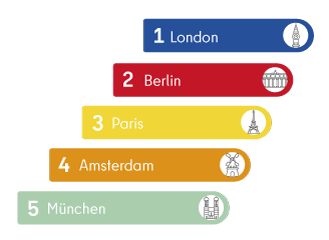 With 31.6% of start-up votes, Berlin has retained its status as a key magnet for start-ups and confirms its position as one of Europe's most attractive innovation hubs, just behind London (32.6%).