Energy grids and storage
The Berlin-Brandenburg region is making a valuable contribution to the development of smart grids, storage concepts and innovative solutions for sector coupling between energy infrastructures.
Numerous innovations come from the region
In the energy self-sufficient village of Feldheim (Brandenburg), private local heating and electricity networks supply consumers and businesses directly with regional energy from wind, biogas, and wood chips. A battery storage system compensates for fluctuations in wind power.
At ENERTRAG's hydrogen hybrid power plant (Prenzlau), green hydrogen is produced from wind power through electrolysis, stored, and converted into electricity and heat in a combined heat and power plant as needed. It can also be used as fuel for vehicles and in industry.
At he EUREF Campus (Berlin), a local "micro smart grid" with central load management by NBB Netzgesellschaft Berlin-Brandenburg ensures an almost CO₂-neutral energy supply. In addition, GASAG Solution Plus has integrated a 500 kWel P2H and a P2C plant into the existing heating and cooling supply system in order to store surplus energy flexibly as heat or cooling.
The state-owned company BEW Berlin Energie und Wärme GmbH operates Europe's largest power-to-heat plant with a total output of 120 MWth. This replaces the "C" coal-fired unit at the Reuter cogeneration plant and supplies district heating to up to 30,000 households. It is connected to Germany's largest heat storage facility, which can supply heat for up to 13 hours with a thermal output of 200 MW.
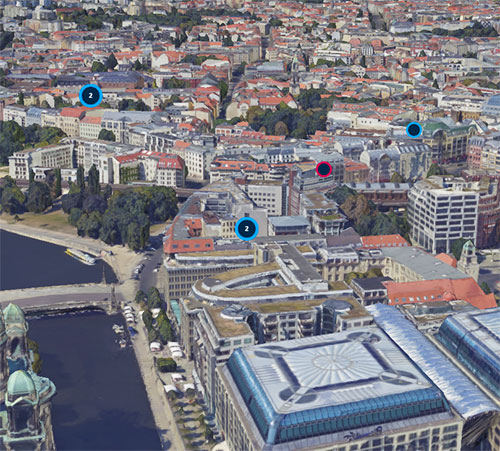
Blockheizkraftwerks- Träger- und Betreibergesellschaft mbH Berlin (BTB) operates an innovative CHP system with two river water heat pumps and four highly efficient gas CHP engines (32 MW thermal, 18 MW electrical). The gas components are to be converted to hydrogen operation.
About the Capital Region
„The specific combination of Brandenburg, a region with a high level of wind energy conversion, and Berlin, which has a high population density, offers outstanding potential for integrating renewable energy. Smart grid technology can be used to control storage systems and flexible loads, and managing cross-medial grids for electricity and heat.“

Berlin-Brandenburg is the ideal location for development and testing
- Leading in the development and management of energy networks with a high proportion of renewable energies
- Development and integration of energy storage technologies for grid stabilization
- Expertise for system security in complex energy networks
- Management of multi-sectoral infrastructures (electricity, heat, water) and optimization in terms of efficiency and safety
- Development and implementation of sector coupling for:
- Heat (power-to-heat) generated by heat pumps (river water and wastewater)
- Hydrogen deliver (power-to-gas), transport and storage;
- electromobility (power-to-mobility) and hydrogen for mobility (H₂-to-mobility) for public transport (rail and buses), logistics, and cars
Close cooperation of science and industry
- With the GridLab, the region has a unique research and training infrastructure for network simulation under operating conditions.
- At BTU Cottbus Senftenberg, sector-coupled energy systems (heat, electricity, storage and mobility) based on green hydrogen are being operated as part of the Energy Storage and Conversion (ESC) Lab.
- In the Smart Grid Laboratory at TU Berlin, electricity, heating and cooling grids, including generators, storage systems and consumers, can be simulated in their interaction.
- HTW Berlin has a special focus on the intelligent linking of photovoltaic systems with battery and heat storage.