Berlin Aerospace Center
The aerospace industry is one of the capital region's most important future industries. It combines a high level of innovation with sophisticated technology.
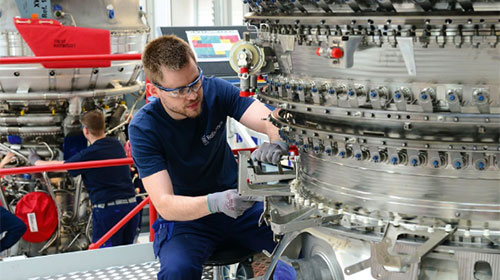
The capital region ranks among the three most important locations for aerospace technology in Germany. With global players such as Planet Labs, Rolls-Royce and MTU, world-renowned aerospace companies are in the region. In their environment there are many opportunities for small and medium-sized enterprises as suppliers or in the service, security, or IT sectors. They all benefit from exceptionally high scientific and research potential in the capital region.
Why Berlin?
„Small satellites are the future of space travel. Berlin is both where this technology was born and remains its most important location in Germany. For more than 20 years, this innovation has taken place in companies, research institutes, and universities. The value chain from system technology to the marketing of data products is at home here in the capital region.“

Facts and figures
- About 7,500 specialists, technicians and engineers work for aerospace companies in the capital region
- Approximately 17,000 employees work in the aviation industry
- Venue of the Innovation and Leadership in Aerospace Berlin (ILA), the third largest trade fair in the world in this segment, and one of the highest-selling
- Optimal networking in and with the regional aerospace industry via the Berlin-Brandenburg Aerospace Alliance (BBAA)
- Regional core competencies of the companies in satellite technologies, propulsion technology, maintenance, overhaul and repair (aircraft maintenance), simulation, testing, engineering and software development as well as the design of urban airspace (UAM)
Competence center for space technologies and New Space
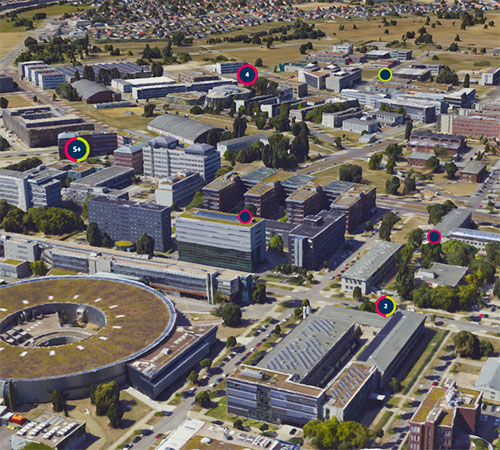
Traditionally, the small satellite segment has shaped the regional space sector. Three companies in the region manufacture small satellites: Astro- und Feinwerktechnik Adlershof GmbH, Berlin Space Technologies and the TU Berlin. The TU Berlin is the university with the most satellites in orbit worldwide.
With the theme of "New Space," a growing number of startups based here are conquering the new market. In 2021, for example, the Berlin-based startup LiveEO, Inc. used satellite data to analyze the entire US power grid, covering more than 7 million miles, for the first time.
More than 70 companies, training institutions (e.g., beSpace, Inc.) and research centers (e.g., DLR, HU Berlin, Ferdinand Braun Institute) in the capital region are striving to reach space. They pool their expertise and form a comprehensive, interdisciplinary regional center of excellence for space technologies and applications.
Regional drone technologies conquer the market
Civilian unmanned aircraft systems have been added as a new category. Over 60 stakeholders from the fields of research (e.g., DAI Labor, European Aviation Security Center), development (e.g., germandrones GmbH, Multirotor Beteiligungsgesellschaft mbH, BärDrones) and application (e.g., Airteam) are developing the capital region into a leading location for unmanned flight. Model projects such as the transport of laboratory samples and medicines at Berlin's Charité hospital are opening up urban airspace.
Selected aerospace companies and research institutions
Networks, initiatives and associations
Research environment
Companies and suppliers in the aerospace industry benefit from the expertise of a strong regional research network:
- TU Technical University of Berlin (Raumfahrttechnik, Logistics, Mechanical Engineering and Transport Systems)
- Brandenburg University of Technology Cottbus–Senftenberg
(Brandenburgische Technische Universität Cottbus-Senftenberg - BTU) - Wildau Technical University of Applied Sciences
(Technische Hochschule Wildau) - Brandenburg University of Applied Sciences
(TH Brandenburg a. d. Havel) - Fraunhofer Institute IAP - Polymercomposites PYCO
- Fraunhofer Institute for Production Systems and Design Technology
(Fraunhofer Institut für Produktionsanlagen und Konstruktionstechnik - IPK) - BHT Berliner Hochschule für Technik
- Embry-Riddle Aeronautical University
- European Aviation Security Center EASC e.V.
- Federal Institute for Materials Research and Testing
(Bundesanstalt für Materialforschung und Prüfung - BAM) - German Aerospace Center
(Deutsches Zentrum für Luft- und Raumfahrt e.V. - DLR) - GFZ Helmholtz Centre for Geosciences
(GFZ Helmholtz-Zentrum für Geoforschung) - HU Humboldt-Universität zu Berlin
- FBH Ferdinand-Braun-Institut
The TU Berlin established Germany's first chair for space technology in 1963 and is now one of the most renowned institutions worldwide – and the university with the most satellites in orbit.
The Fraunhofer Institutes and the German Aerospace Center (DLR) in Berlin undertake research and development contracts from regional industry.
The University of Potsdam operates a research center for public law, media law, and air and space law.
The DLR mission MERTIS is mapping Mercury's temperatures. The PLATO space telescope has been on its way to Mercury since 2018 under Berlin's leadership to measure the atmospheres of planets outside our solar system. In 2020, several instruments were tested on Venus during a flyby.